Case Studies
LINEs4Palestine: An international collaboration for ELT capacity building in times of genocide
by Dr Maria Grazia Imperiale (Lecturer in Adult Education at the School of Education, University of Glasgow)
We are a team of academics based at the University of Glasgow and the University of Porto: Maria Grazia Imperiale, a Lecturer in Adult Education in the School of Education (University of Glasgow – UofG, Project-Lead), Giovanna Fassetta (UofG, Project Co-Lead), Sahar Al-Shobaki (UofG, Project Coordinator) and Damian Ross (University of Porto, Project Co-Lead). Together we worked on the LINEs4Palestine project. As a team, we have been working with colleagues based in Gaza for over 10 years, collaborating on several projects linked to language and intercultural education.
The first two months after the start of the war, in October 2023, saw us completely paralysed, spending nights awake on WhatsApp and following the news, feeling useless, sad, angry and frustrated. Seeing a call for funding from the British Council was the stimulus we needed, and we decided to make use of our expertise in what we thought would be a productive way. We thus applied and secured this funding, which allowed us to conduct the LINEs4Palestine project.
A participatory approach: how LINEs4Palestine emerged
The LINEs4Palestine project emerged from consultation with our colleagues and contacts in the Gaza Strip. Our ethos has always centred on participatory approaches, recognising our partners as the experts in their contexts. Amid genocide, a collaborative and participatory approach is the only possible way forward and, back in January 2024, we sought trusted colleagues’ insights on priorities and the feasibility of projects in the context of the ongoing horror. Their guidance shaped LINEs4Palestine. They advised us to focus on capacity building for ELT and Education students and graduates, who would not have the possibility to continue their studies due to the destruction of all HE infrastructures in Gaza. These individuals represent the future generations who will be tasked with re-building education in Palestine, and they need opportunities to complete their studies.
Our Partnership with HopeHub
At the heart of LINEs4Palestine was a commitment to connection. We partnered with HopeHub in Gaza, which is an initiative set up in January 2024 to establish internet and learning hubs across the Gaza Strip, to allow freelancers and students to continue working. Through HopeHub, we tried to ensure that Palestinian students and people interested in the project could access “stable” internet and a laptop lending service. The critical support provided by HopeHub allowed many Palestinian people to join LINEs4Palestine, and over 200 people signed up for the project, with approximately 80% based in Gaza.
Project activities: Workshops, Mentoring, and a Mini-Conference
Recognising that the needs of the community are best defined by its members, the project team then conducted a needs analysis, and we asked our Palestinian participants what kind of academic support would have been helpful.
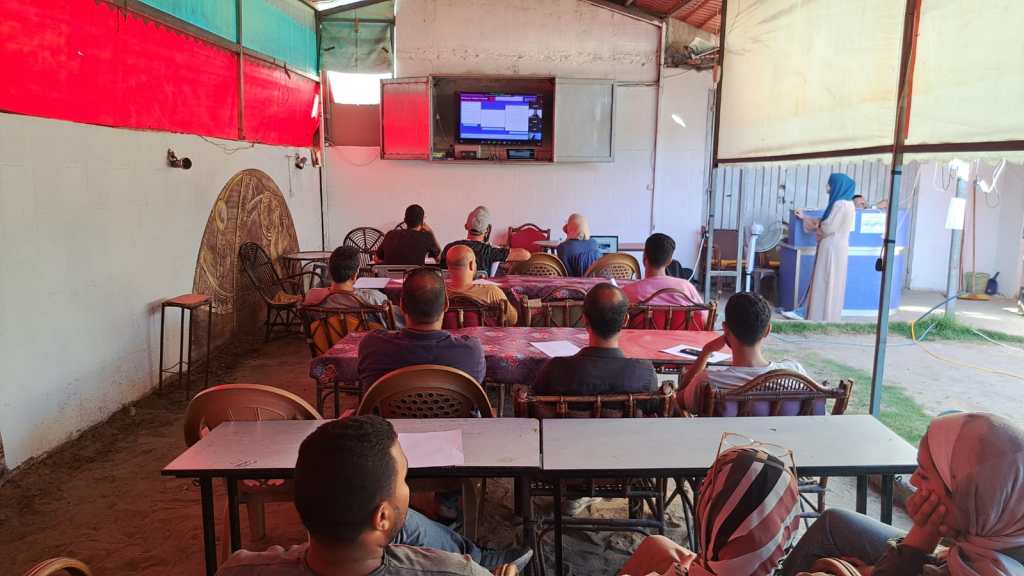
The needs identified guided the development of a series of 11 interactive online workshops covering essential academic skills such as academic publishing and crafting PhD proposals, as well as education-related topics. These online sessions, led by colleagues from the UofG School of Education and the Research Development team in the College of Social Sciences who volunteered their time, attracted an average of 40 participants per workshop.
Complementing the workshops, we set up mentoring opportunities, which offered up to 6 hours of one-to-one guidance. Seventeen mentees were paired up with mentors (UofG colleagues who volunteered their time) and they engaged in personalised sessions focusing on key objectives that the mentees had identified (e.g., scholarship applications, journal article publication, design of innovative teaching resources).
We also hosted a mini-conference, which saw presenters from Gaza and Glasgow get together on Zoom to discuss research and teaching. The mini-conference was a joyous day. It was held on the 30th of August 2024 – after some of the hardest weeks in Gaza. Connecting from a very precarious situation, presenters from Gaza were able to explain how they were continuing teaching in education tents, or how they were trying to focus on completing a publication while witnessing massacres, or after being displaced for the 10th time. PhD students and Master’s students from the UofG also had the opportunity to present their research studies. We also listened to a keynote delivered by Prof Evelyn Arizpe on using picturebooks in challenging contexts. It was a very powerful and humbling day, which demonstrated how, although extremely challenging, simple, quiet acts of academic solidarity can benefit both Palestinian and local, UK-based students and academics.
Impact
The impact of LINEs for Palestine has been profound. Participants described the project as a “lifeline,” a “candle of hope in the hardest times,” and something that truly “helped them get through their days” and “made [them] feel a sense of normality.”
For all of us in the team, and for our colleagues involved in delivering the workshops and mentoring sessions, the project was an opportunity to feel that, at the very least, we were ‘doing something’, standing in solidarity with our Palestinian colleagues, their students, and their community. Many UK academic institutions, including the UofG, openly commit to social justice and uphold values of integrity and truth, and this project demonstrates that there are ways to maintain these commitments, even in the hardest times of profound social injustice, when they are especially needed, and that we – as academics and practitioners – can do so in concrete terms if we are open to listen and learn from those on the ground.
LINEs4Palestine showed that putting in place educational activities for students and staff in Gaza – although extremely challenging – can work in practice.
Looking Ahead
We are now starting LINEs4Palestine 2, an expansion of the project. This is funded by the School of Education (UofG). LINEs4Palestine 2 entails working with the UofG and other institutions to offer academic support in a range of subjects beyond education, and will also include a pilot of collaborative online teaching activity that aims at developing students’ knowledge exchange and co-creation.
A public event is planned for the end of April, where our ‘multivocal’ project report and our open-access resource will be officially launched. The event details will be advertised on the RefugEAP Network JISCmail list (subscribe here) and on the University of Glasgow website.
If you are interested in connecting and would like to be informed about our upcoming events and future activities, or if you would like to set up something similar in your institution, we would love to hear from you. Just drop us an email: Maria.Imperiale@glasgow.ac.uk.
Dr. Maria Grazia Imperiale is a Lecturer in Adult Education at the School of Education, University of Glasgow. She is the project lead for: LINEs4Palestine, which provides academic support to English and Education graduates through online workshops and mentoring; Education in Conflict, which focuses on institutional capacity-building, particularly at the Islamic University of Gaza (IUG); and LINEs4Palestine 2, an expansion of LINEs4Palestine. She has worked on multiple collaborative research projects in contexts of protracted crises and led the LINEs project on informal education in refugee settings in Lebanon and Jordan. With a background in applied linguistics and intercultural education, her research interests centre on language and intercultural education for refugees and adult migrants, and refugee and adult education in precarious contexts.
 RefugEAP Network
Leave a reply to Building bridges with Palestine: DSA 2025 reflections on what higher education can and must do – Global Development Institute Blog Cancel reply