Testimonial
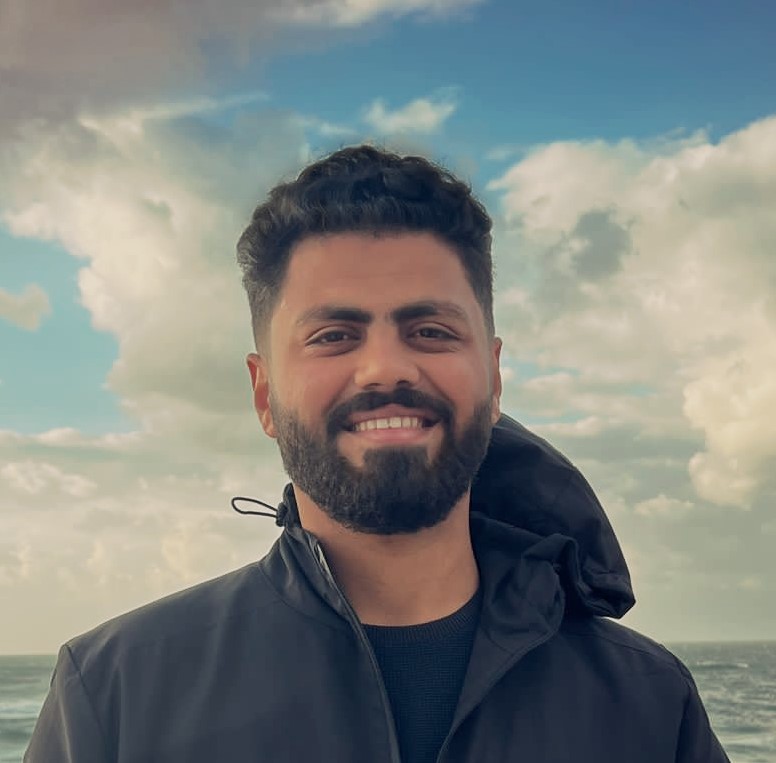
Testimonial of an online pre-sessional student displaced in Gaza
by Ibrahim Aldalis (a University of Birmingham pre-sessional student in Gaza)
Please consider contributing to Ibrahim’s GoFundMe campaign
My name is Ibrahim Aldalis, and I am a civil engineer from Gaza. As I write this from a small tent in a crowded displacement camp in the central area of the Gaza Strip, I want to share a story not just of hardship, but of resilience and opportunity. Despite the turmoil surrounding me, the pre-sessional English for Academic Purposes (EAP) online course at the University of Birmingham, offered through the RefugEAP Network initiative, has given me something invaluable: hope. This course was more than just an educational opportunity; it became a lifeline to a future that, until recently, felt distant and unreachable.
A Vision Interrupted: My Academic Journey Before the War
Before October 7, 2023, I was deeply immersed in my academic and professional aspirations. I was completing my MSc in Water Resources Engineering while working as a GIS engineer at the Municipality of Gaza. But on that fateful day, everything changed. The ongoing conflict ravaged the Gaza Strip, shattering lives and dismantling the very infrastructure of learning. My university’s campus was left in ruins, my thesis work unfinished. The dreams I had nurtured for years seemed to crumble overnight.
Still, I refused to give up. Even as I navigated life amidst a war zone, I continued to pursue higher education opportunities abroad. I applied for several scholarships, hoping one might offer a path forward. Incredibly, I was awarded the Copty Scholarship for an MSc in Environmental Engineering at Queen’s University Belfast. But there was another hurdle: the English language requirement. With no IELTS exams available in Gaza due to the war, the very scholarship that promised hope felt like it might slip away.
Then I discovered the RefugEAP Network, a beacon of light amid the darkness. Through this initiative, I applied for the pre-sessional EAP course at the University of Birmingham, which ultimately became my lifeline. Queen’s University agreed to accept the pre-sessional results, giving me the chance to meet my scholarship’s requirements despite the overwhelming odds.
What It Was Like Studying Online: A Lifeline to a World Beyond War
Studying online in the pre-sessional course from Gaza was like reaching out to a world that felt impossibly far away but within grasp. The course was challenging, designed to rapidly develop our academic English skills. Each day was filled with rigorous lessons in reading, writing, speaking, and listening, all tailored to the context of academic life in the UK.
What struck me most was not just the academic content but the human element of the course. My tutors didn’t just teach—they cared. They knew that my situation was far from normal, and they responded with patience, empathy, and flexibility. Their support went beyond mere lessons. They provided one-on-one feedback, not just on how to write better essays, but on how to navigate my educational journey under the most difficult circumstances imaginable.
The course also introduced me to research and innovation through an English for Specific Academic Purposes (ESAP) project. I worked with peers from different cultural backgrounds, gaining a sense of the global academic community I had long dreamed of joining. In a region as isolated as Gaza, this experience was nothing short of transformative.
The Unseen Struggles: Navigating War While Studying
But the road was not smooth. Gaza is a place where simple daily routines—like accessing the internet or having consistent electricity—are luxuries. My struggle was not just intellectual; it was physical. Every time the power went out, I lost my connection to the course. I had to relocate multiple times in search of a stable environment where I could focus. I joined classes from public spaces, refugee shelters, and borrowed homes, knowing that missing even a single session could derail my progress.
Yet, in the face of these barriers, I kept going. I wasn’t just driven by my personal ambition, but by the knowledge that this opportunity was my bridge to a better future. And I wasn’t alone—my tutors and the course coordinators stood with me every step of the way, adjusting deadlines, offering additional support, and making sure I could keep pace despite the chaos around me.
Overcoming with Determination and Support
What allowed me to succeed in the pre-sessional course was not just my own resilience, but the unwavering support from the academic staff. Their flexibility—recapping missed lessons, offering extra tutorials, and providing understanding where strict rules might have otherwise prevailed—was a game-changer. Their commitment to my success went beyond the classroom and reminded me that education is not just about imparting knowledge, but also about nurturing potential.
The course itself was designed with understanding at its core. It wasn’t just about passing exams; it was about building confidence, fostering connections, and ensuring that students like me could see a path forward. This is the kind of support Gazan students, and all refugee-background students, need to thrive.
A Call to Action: Advice for Universities and Organizations
My experience underscores the enormous potential that pre-sessional courses can unlock for students from challenging environments. For UK universities and educational organizations seeking to support Gazan students, here are three key recommendations:
- Recognize the resilience of Gazan students: Despite the unimaginable hardships they face, students in Gaza are driven by an unwavering desire to learn and grow. Offering more pre-sessional courses for students like us can be transformative, helping bridge the gap between limited local resources and international academic opportunities.
- Prioritize flexibility and empathy in course delivery: Gazan students are studying under extreme conditions—power outages, unstable internet, and the constant threat of violence. Universities must offer flexible learning options, such as asynchronous lessons, recorded materials, and extended deadlines, to ensure that these students can fully engage with the course despite the obstacles.
- Collaborate across universities: One of the biggest challenges is ensuring that pre-sessional course results are recognized by multiple institutions. If UK universities work together to create a unified framework for accepting pre-sessional outcomes, it would open doors for students who cannot access formal English language exams in conflict zones like Gaza.
A Message of Hope
My journey through the University of Birmingham’s pre-sessional course was not just about learning English—it was about reclaiming a future that war had tried to take from me. The course allowed me to meet the language requirements for three UK scholarships, making my dream of studying in the UK a reality. This wouldn’t have been possible without the understanding and support I received.
I hope that my story not only inspires others who face similar struggles but also informs universities and organizations about the transformative impact they can have. Education is not just a pathway to personal success—it is a lifeline for entire communities. With the right support, students like me can go on to create meaningful change in the world, no matter where they come from.
The war may have destroyed buildings, but it could not destroy our hope. And through initiatives like RefugEAP, we can turn that hope into reality for many more students like me.


 RefugEAP Network
Leave a reply to David Cancel reply