
Case Study

Implementing research / researching implementation: Integrating trauma-informed pedagogy in training MSc TESOL students volunteering to teach English to Ukrainian Displaced People
by Dr Tomasz John (Teaching Fellow in TESOL and Intercultural Communication at University of Strathclyde, Glasgow)
The Rationale
Due to the ever-increased demand for English for Speakers of Other Languages amongst refugees, asylum seekers and forced migrants in Glasgow, Scotland, there is a growing interest in providing specialist English provision to vulnerable adults and children amongst various educational stakeholders, including ESOL and EAL (English as an Additional Language) in Further Education colleges, primary and secondary schools, community centers and charities across the city. Recognizing the demand for tailored English language provision that acknowledges and addresses some of the unique challenges that these learners face, such as having trauma and PTSD, University of Strathclyde lecturers teaching on the MSc TESOL and International Communication and BA Education and TESOL programs – Tomasz John and Joanna McPake – decided to implement opportunities for their students to not only observe teachers in action and support vulnerable learners, but also develop access to potential data for the students’ research projects.
Trauma-informed Pedagogy
As part of the preparation, students received training on volunteering, teaching vulnerable adults and migrant children and utilizing trauma-informed pedagogy. Trauma-informed pedagogy in English language teaching refers to an approach that recognizes the impact of trauma on students’ learning and well-being and seeks to create a safe and supportive learning environment. According to research, trauma can affect cognitive and emotional functioning, which may hinder learning and academic performance (van der Kolk, 2014). As such, trauma-informed pedagogy seeks to provide a supportive and empowering learning experience that can help students to overcome the effects of trauma and achieve their goals.
One key aspect of trauma-informed pedagogy is the recognition of students’ experiences and the incorporation of trauma-sensitive practices into teaching. This can involve creating a safe and predictable learning environment, providing opportunities for self-expression and choice, and using instructional strategies that promote engagement and self-regulation (Olson & Dutta, 2019).
Another important aspect of trauma-informed pedagogy is the use of culturally responsive teaching practices that recognize and validate students’ cultural identities and experiences. By incorporating diverse perspectives and experiences into the curriculum, teachers can help to create a sense of belonging and promote engagement among students from diverse backgrounds (Hammond, 2015).
Overall, trauma-informed pedagogy is a critical approach in English language teaching that seeks to support students’ academic achievement and well-being. By recognizing the impact of trauma on learning and incorporating trauma-sensitive and culturally responsive practices, teachers can create a safe and empowering learning environment that promotes engagement, growth, and success.
The Teaching – Research Nexus
So far, the pilot of the project has allowed students to observe, teach and reflect on their engagement with the English language provisions offered by various organizations including the SCILT (Scotland’s National Centre for Languages), AUGB (The Association for Ukrainians in Great Britain), Glasgow Clyde College ESOL provision, CWIN (Central and West Integration Network charity), and EAL teams across primary and secondary schools in Glasgow.
This current stage of the project focuses on early outcomes from the pilot programme to integrate trauma-informed pedagogy in training for students enrolled on a MSc in TESOLIC and volunteering to teach English to Ukrainian Displaced People. The teaching research nexus (McKinley, 2019; McKinley et al., 2021), which refers to the overlap between research into language teaching and the teaching itself, is fundamental to this discussion, as the researchers/ teacher-educators and student-volunteers engage in a cycle of research-training-teaching-reflection-research:
The Reflective Cycle
Research: Trauma-informed pedagogy (Finn, 2010; Furneaux, 2018; Palanac, 2019; Stone, 1995) recognises and addresses the effects of trauma on the learning and development of individuals, and highlights the importance of creating a safe and supportive learning environment that fosters trust, empathy, resilience and growth.
Training: Drawing on this research, the researchers / teacher-educators devised and piloted a training programme for student-volunteers, incorporating a trauma-informed approach to teaching English to Ukrainian Displaced People.
Teaching: Student-volunteers observe, assist and teach classes for Ukrainian Displaced People attending a regular drop-in programme of English classes.
Reflection: Students-volunteers and researchers / teacher-educators meet on a regular basis to review experiences, compiling reflective diaries which focused on the impact of the trauma-informed pedagogy element of the training, among other features.
Research: Students-volunteers draw on their experiences and reflections for their dissertations, while researchers / teacher-educators analyse the data collected over the course of the cycle to develop understandings of how training for trauma-informed pedagogy can be effectively implemented.
Early Findings and Future Plans
Tomasz and Joanna hope that engaging the various stakeholders in filling the gap triggered by the teaching-research nexus will not only enhance the quality of learning and teaching, and the content of the training, but also enrich the research process itself. This view is supported by a growing body of literature, including the work of scholars such as Chick and Coombe (2018), who contend that “research and teaching are not separate, but rather intertwined and interdependent.” We want to emphasize the importance of promoting a culture of inquiry in which teaching and research are mutually reinforcing, and we aim to further develop collaborative partnerships between the TESOL programs, students, and ESOL provision providers which can foster a shared commitment to learning and discovery.
As the intervention has, so far, created greater awareness of the challenges that all the stakeholders might encounter in working with vulnerable adults, early findings suggest they felt more confident with handling trauma-related issues in the classroom context and that the on-going cycle integrating research and teaching practices allows them to make informed decisions about their respective learning, emerging teaching strategies and developing understanding of the research. Here are a couple of testimonies from our student-volunteers:
Testimonials
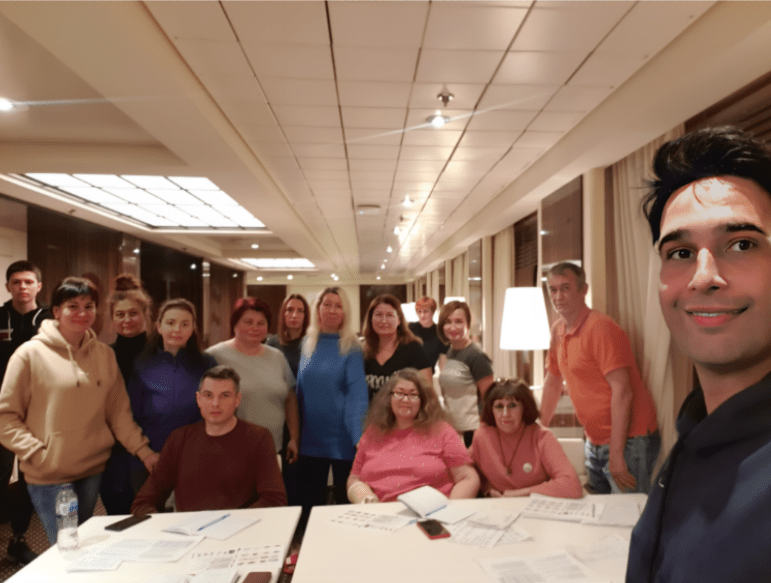
Mehrdad Mohajeri from Iran (a current Strathclyde PhD student researching the use of drama and humour in an ESOL class as a tool supporting vulnerable learners; student-volunteer)
“As part of my PhD project, I taught an ESOL course to 17 Ukrainian students at elementary level. I also received training on trauma-informed pedagogy, which, combined with my ongoing literature review on trauma-informed teaching and learning, provided me with valuable insights into creating a safe and supportive learning environment. Overall, the experience was rewarding for both me and the students. “
Wenwen Zha from China (former MSc TESOLIC student; student-volunteer)
“I started to know my student’s situation and the best English class they need, according to their needs. As a teacher, I paid attention to their mental health, not just teaching techniques. I signed up for a training session on trauma-informed pedagogy to become more professional as an English teacher for refugees. After two months of theoretical and practical training, I felt I was able create safe learning atmosphere and enjoyable classes.”

References
Chick, N. L., & Coombe, C. (2018). The nexus of teaching and research: A framework for engaging faculty in applied research for improved student learning. Journal of Applied Research in Higher Education, 10(2), 120-132. doi: 10.1108/JARHE-08-2016-0075
Finn, H.B. (2010). Overcoming barriers: Adult refugee trauma survivors in a learning community. TESOL Quarterly 44(3): 586–596 https://doi.org/10.5054/tq.2010.232338
Furneaux, C. (2018). Trauma and second / foreign language learning. In T. Capstick (ed.). Language for Resilience: Cross-Disciplinary Perspectives. http://www.britishcouncil.org/sites/default/files/language_for_resilience_-_crossdisciplinary_perspectives_0.pdf (accessed March 2023)
Hammond, Z. (2015). Culturally responsive teaching and the brain: Promoting authentic engagement and rigor among culturally and linguistically diverse students. Thousand Oaks, CA: Corwin.
Lloyd, B. (2019). Creating a Safe and Inclusive Learning Environment for Adult Learners. The Journal of Continuing Education in Nursing, 50(1), 8-11
McKinley, J., McIntosh, S., Milligan, L., & Mikołajewska, A. (2021). Eyes on the enterprise: problematising the concept of a teaching-research nexus in UK higher education. Higher Education, 81(5), 1023–1041. https://doi.org/10.1007/s10734-020-00595-2Mckinley, J. (2019). Evolving the TESOL Teaching–Research Nexus. TESOL Quarterly. doi:10.1002/tesq.509
McKinley, J. (2019). The teaching-research nexus: A framework for enhancing scholarship and practice in higher education. Higher Education Research & Development, 38(2), 345-358. doi: 10.1080/07294360.2018.1537845
OECD. (2019). Education at a Glance 2019: OECD Indicators. Paris: OECD Publishing
Olson, M. E., & Dutta, U. (2019). Trauma-informed approaches to teaching English language learners: Practical applications for the classroom. New York: Routledge
Palanac, A. (2019) Towards a trauma-informed ELT pedagogy for refugees. Language Issues 30(2) https://www.researchgate.net/publication/341452361_Towards_a_trauma-informed_ELT_pedagogy_for_refugees
Stone, N. (1995). Teaching ESL to Survivors of Trauma. Prospect 10(3): 49-57
Tannenbaum, R. J. (2019). Adult Literacy Programs: Design, Implementation, and Evaluation. New York: Routledge
van der Kolk, B. A. (2014). The body keeps the score: Brain, mind, and body in the healing of trauma. New York: Penguin Books
Dr Tomasz John (he/him) is a Teaching Fellow in TESOL and Intercultural Communication at University of Strathclyde (Glasgow). Tomasz worked as an EAP practitioner and Head of EAP for over 10 years. He’s a Co-convener and Comms Officer of the BALEAP EAP4SJ SIG. Tomasz is passionate about ethical and comprehensive internationalisation of HE, decolonisation of curriculum and representation in ELT . Find out more about his work here . Contact: tomasz.john@strath.ac.uk @tomaszjohn84
Hi Ibrahim. I am also a pre-sessional teacher at the University of Birmingham. This year I was teaching face-to-face. I…
You amazed me every single day Ibrahim, dispite the genocide happening all around you, you continued in the midst of…
I observe hope. It is the hope that Employers and Countries find ways to truly see past colour, gender, language,…
You’re a source of inspiration Ibrahim, stay strong!


 RefugEAP Network
[…] of Glasgow has an international English Language Teaching collaboration with Gazan scholars through LINEs4Palestine program. Through this initiative, they…