
Case Study

Utilising universities as ESOL providers
by Sadie-Jade Fouracre-Reynolds (EAP Practitioner, Swansea University)
Back in 2021 we received RWIF funding as part of a successful joint bid with other departments in the university to provide activities aimed at helping participants to progress in their learning and future career development. Our part in this was to deliver language teaching to a cohort unable to access traditional provision, which gave us the opportunity to offer an ESOL course for the first time.
Identifying need and finding funding
In Swansea, as in many other areas, ESOL providers almost always have extensive waiting lists. So, our first step was to work with existing local providers to identify the level at which there was the greatest need for provision that year: ESOL Entry 3 (E3). Then by building on our successful community class project, consulting with community learners, and utilising our connections with local organisations we were able to identify some of the key factors preventing learners based locally from attending traditional ESOL classes available in the area.
These factors included caring commitments, access to transport, health issues, temporary accommodation issues and the prohibitive length of commitment usually needed which led to the decision to offer a programme of ESOL for 20-weeks over six months delivered predominantly online with regular but optional face-to-face activities offered alongside the core curriculum. We did this in partnership with Trinity College and funded exams and accreditation through their Language Access Fund. This gave learners an opportunity to earn a recognised qualification at the end of their course.
What success looks like
We had a lot of interest, tested 32 potential learners and were able to offer 18 places. Of these 18, 10 successfully completed the 6-month course. This isn’t the kind of ‘success rate’ that we’re used to in EAP, where we tend to focus on learners whose sole focus is study and expect 90+% pass rates on our pre-sessional courses. So, how could I see a just over 50% pass rate as a success?
To understand this, we first need to look at those learners who completed the course. We saw language progression in each of them. They all achieved a Trinity E3 certificate in at least one skill area and 80% of them achieved the full E3 award. They achieved this in the space of 6 months, when it would usually take nine, and thanks to the January start date, were then in a position to progress to the next stage in their learning at the beginning of the next academic year.
We then turn to the withdrawals. The reasons for losing three of our learners were unfortunately out of our control. The outbreak of war in Ukraine shifted focus dramatically for two and they were understandably unable to continue, though one of them drops-in to the community classes when he can. Our final student withdrew due to Covid19 related ill-health.
However, for the majority of those who did not complete, we still saw individual progression. Two progressed in confidence in their language use so much within the first ten weeks of the course that they were able to secure employment. These new jobs meant that they couldn’t commit to 2hrs classes each weekday and the self-study needed to complete the course, but this was a hugely positive step for them. Three of the learners found the pace and level of the course more challenging than they’d expected, so withdrew. But, with support from tutors, were encouraged to engage with our community classes and continue to learn and progress with us. They’re now ready to engage again with higher level learning.
So, all in all we delivered a successful course and learned a lot along the way about the ways in which we can better support learners and provide flexible education opportunities that are easier to access. But why were we well placed to do this and should ESOL really have a place as part of university language provision?
Different ‘types’ of language teaching
The arguments surrounding language teaching at different types of institution tends to focus on the idea of different types of language teaching for different types of provision. However, having trained and taught at a wide variety of different institutions offering EFL, EAL, ESOL, EAP and CLIL to name a few, my potentially controversial assertion would be that the teaching of language across each of these is broadly the same and that the difference occurs based on the focus, motivation and needs of the learners.
We can make generalisations about these differences between for example ESOL and EAP, but the reality is that we also see most of these differences within single classrooms. For instance, when working with a group of EAL learners the common factors tend to be their age and need to learn English, but the focus for each of them might be wildly different. Some just want to fit in with their peers while others want to get out of school and into work and the rest are hoping to study at university.
Applying this idea to our recent experience with ESOL learners paints a similar picture. Of our cohort, their common goal was to learn English to enable them to build a life in an English-speaking country. But that looked different for each of them. Most were learning – as expected given the usual view of ESOL – to support their families or to gain access to employment. But for several, their route to doing this included future study and ambitious career goals.
ESOL as a step on pathways to universities
40% of our successful ESOL learners last year came to us in part because they’d like to study at an English medium university in the future. Some came to us initially as beginners in our community classes and by providing ESOL at E3 we were able to offer them a link between their existing language learning and their future goals. Two of those learners are now studying with us on our pre-sessional courses – with support from Refuaid – and I hope to be able to share with you their successful entry to post-graduate higher education very soon.
Consistent and visible pathways to learning at every stage are important. And including ESOL as one of the steps is a way of doing this successfully for our students and our communities.
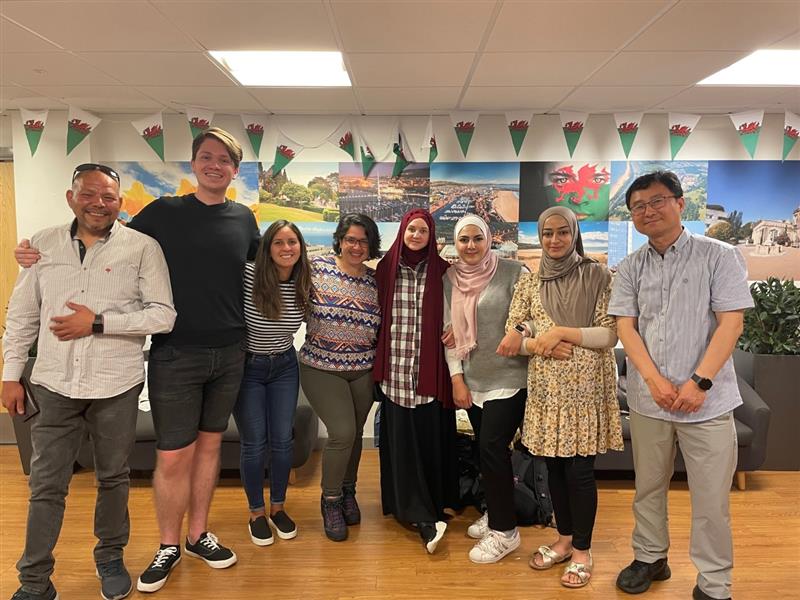
Swansea University Community Classes students celebrating the end of exam day with their teacher
Sadie-Jade Fouracre-Reynolds (EAP Practitioner, Swansea University) is a language teacher of two decades with a background in science. She has worked in a wide range of contexts including EAP, ESOL, EAL and CLIL. A combination of teaching experience, course development, material creation and outreach project management has fed into her work with vulnerable communities and development of teacher support and mentoring programmes. Contact: s.fouracre-reynolds@swansea.ac.uk
[…] of Glasgow has an international English Language Teaching collaboration with Gazan scholars through LINEs4Palestine program. Through this initiative, they…
Hi Ibrahim. I am also a pre-sessional teacher at the University of Birmingham. This year I was teaching face-to-face. I…
You amazed me every single day Ibrahim, dispite the genocide happening all around you, you continued in the midst of…
I observe hope. It is the hope that Employers and Countries find ways to truly see past colour, gender, language,…
You’re a source of inspiration Ibrahim, stay strong!


 RefugEAP Network
Leave a comment